
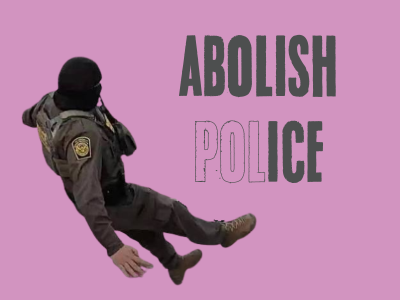
A vast, grassroots movement against Immigration and Customs Enforcement (ICE) has sprung up in multiple major US cities, and in Minneapolis, dealt the Trump administration its first real—albeit qualified—defeat of its second term. The call to abolish ICE has once more taken center stage as wide layers of people are newly mobilized to protect their neighbors and their cities. But what does it mean to abolish ICE in the context of an ever-growing police state?
For many, the recent spectacles of ICE’s violent abuse is a clear overreach, fueling calls for a return to constitutional or legal border enforcement. For yet others, a key ally in the fight to protect our cities from federal government attacks are local police. Both of these frameworks rest on an assumption that ICE is a rogue agency disconnected from an otherwise tolerable law enforcement system. But when we look at the role ICE—and Customs and Border Protection (CBP)—play within the larger US carceral state, it becomes clear that these border agencies should be seen as intimately connected with the overall trend of escalating militarization and policing in this country.
Even more so after its massive funding increase, ICE operates in lock step with police departments across the country to arrest and jail immigrants and suppress protests. The spectacular raids of sanctuary cities would not be possible without this deep interconnection. Historical abolitionist experience points to the pitfalls of attempts to merely reform ICE to look and act more like “regular” police. At the same time, the fight to abolish ICE is necessarily connected with the longstanding struggle against policing, including the fight to abolish the police.
To see what it will take to rid ourselves of ICE in any meaningful sense, we have to understand the history and purpose of the agency, and the essential role that police play within its operations.
ICE: A federal police
Founded as part of the Homeland Security Act following the September 11 attacks, ICE was expanded, funded, and deployed as a bipartisan federal policing scheme under four presidents in the last twenty years. The “War on Terror” allowed for the drastic expansion of the US security state, which had lasting effects on policing agencies new and old. As Justin Akers Chacón and Mike Davis write in No One Is Illegal, by 2006 under George W. Bush, the hunt for “domestic terrorists” yielded “paltry results,” which meant enforcement efforts shifted towards “criminal elements.” Even this rationale was soon jettisoned, however, as DHS raised arrest quotas and dropped requirements that those arrested or deported have some other criminal record beyond “ordinary status violator.”1Chacón and Davis, No One Is Illegal: Updated Edition (Haymarket, 2018), 294
Subsequently, under Barack Obama, the Democrats built out the deportation and detention apparatus now being wielded in frightening fashion by the Trump administration. In 2007, a policy of full family detentions was implemented, and in Obama’s eight years in the White House, three million people were deported. Tom Homan, the current border czar, then a leading ICE official under Obama, streamlined the deportation apparatus by tying it more closely with the criminal legal system, yielding a highly “efficient” deportation machine out of the public eye. For his work separating families, Obama awarded him the nation’s highest civil service award in 2014. Republicans, in contrast, preferred a spectacle, with mass raids that disrupt entire communities and campaigns of fear, as with the Build the Wall effort and the Muslim Ban of Trump’s first term. In typical Democratic Party fashion, Joe Biden reversed his position once he came into office to continue building the border wall and deporting more people than Trump had.
To the many, increasing social crises, the ruling class has one all-encompassing solution: more police.
By the time Biden VP and presidential hopeful Kamala Harris was running against Trump’s second bid for the presidency, the Democrats were positioning themselves as more hawkish on immigration enforcement, calling Republicans “too weak” for not supporting a draconian spending bill to increase ICE funding. Parroting Trump’s racist talking points, Harris freely engaged in fear mongering about “transnational gangs, drug cartels, and human traffickers that came into [the] country illegally.”
Beyond the bordering regime, one of the only other funding priorities that received such unquestioned bipartisan support in this period has been policing. Under both Trump and Biden’s presidencies from 2017 to 2025, total police expenditure increased 40 percent, or by $58.3 billion, and one third of that increase came from the federal level. After chants of “Fund them! Fund them! Fund them!” at Biden’s first State of the Union address, US police were flooded with resources: more weapons, more permanent cop training facilities, more surveillance and spy ware, AI-driven facial recognition and license plate recognition devices, all better coordinated though multi-agency fusion centers.
As with ICE, the funding and expansion of police had no measurable correlation with “crime.” Instead, the proliferating social crises produced by capitalism—from the cost of living to lack of affordable medical care to wars abroad, climate disasters, and displacement of populations—have created more and more problems for the ruling class. As argued elsewhere, to these ever-increasing crises, those in power have one all-encompassing solution: more police.
ICE under Trump: the executive’s police
In the case of ICE, we are witnessing the evolution of this police solution in fascistic directions. During Trump’s second term, ICE’s funding has skyrocketed to $85 billion, over fourteen times its budget ten years ago. The explosion of funding has triggered a hiring spree, appealing with white nationalist rhetoric to a base desperate for an economic refuge and the restoration of their personal prestige via state-sanctioned violence. The violence + white supremacy formula isn’t new. It has deep roots in homegrown anti-Black fascism in the US and has long been at work within the US’s many police forces.
ICE’s high-profile surges into sanctuary cities are just as much a war on the public as they are about deporting migrants.
In a border boomerang effect, ICE’s terror against refugees at the border has been forcefully redirected against the interior of the country, and particularly against Trump’s ideological enemies. Along with CBP, ICE has in the process been refashioned into what Michael Macher describes as a “domestic policing omniforce.” “By reconfiguring lines of authority and warping agency functions,” Macher goes on, “it is mounting an existential challenge to the existing terms of order that govern the rights of noncitizens, while turning citizenship itself into a more flexible category.”
The purpose of forming such a modern Gestapo is intimidation and domination. ICE’s high-profile surges into sanctuary cities are just as much a war on the public as they are about deporting migrants: by mid-January, ICE and CBP had amassed over 35,000 weapons outside Minneapolis, the majority of which—tear gas, stun grenades, pepper spray—were intended for protesters rather than “immigration enforcement.” At the same time, despite its expansion, ICE’s terror represents an extension of, rather than a break from, “normal” border enforcement of the past.
“Public safety”, policing, and immigration
For many years now both Republicans and Democrats have been pumping out a narrative in which immigration is an issue of national security and public safety. Similar to “tough on crime” rhetoric that provided cover for the drastic expansion of policing and mass incarceration, the idea that migration is inherently about national security is effective at generating a sense of crisis that mobilizes votes and terminates thought. But it is a lie. Immigration enforcement has nothing to do with public safety, it is about class power.
Criminality or “illegality” are useful ideological categories for those in power, because they are efficient means to disenfranchise whole swathes of the population—immigrants, unemployed people, protesters, homeless people, etc.—and strip them of pesky legal and human rights. As Macher elaborates,
legislative crackdowns on “criminal” immigrants allowed policymakers to pursue expansionary immigration policies by bargaining away the rights of non-citizens; (…) This arrangement suited migrant-dependent business owners, who retained access to a large reserve of non-citizen workers. Without recourse to law, the over nine million undocumented workers in the US are largely under the power of employers.
Immigration or border enforcement, in other words, is not about crime. It is about greasing the wheels of profit for American businesses by stripping the rights of and normalizing a precarious living situation among all workers. The key function of borders, as Harsha Walia succinctly puts it, “is not to deport people, but to create the condition of deportability.” Border enforcement shores up the power of billionaires at the expense of the collective power of ordinary people to build a life for themselves.
Police serve a very similar function under capitalism. The presence of cops does not correspond to actual crime2see chapter 2 of brian bean, Their End is Our Beginning (Haymarket, 2025). Police exist as a threat of state violence to maintain and enforce the conditions for capitalism to smoothly operate, including gross class inequality. For profits to flow, businesses must have a stable and favorable business climate, and cops exist to keep a lid on any challenge to the grotesque inequality created by capitalism. Cops are—to quote police theorist Sydney Haring—the “full time, permanent force capable of continually asserting the power of the capitalist state up and down every street in every city.”
Police and ICE: Hand in hand
ICE’s much-publicized raids of Democratic Party stronghold cities like Minneapolis, Los Angeles, and Chicago have put a spotlight on the violence of the border regime, but these raids were only made possible by the collusion of regular police. Although the key bases of ICE are Texas and Florida, the willing cooperation of local and state police forces in these and other red states has freed up the surge of new recruits to raid northern sanctuary cities. While the degree of cooperation between police and federal border agencies varies from city to city, their overall interconnections are dense and deep, ranging from direct cooperation on raids and arrests to data sharing to protest control.
ICE’s border enforcement has deep ties to the rest of the prison industrial complex.
In thirty-nine states, state and local police play an official, active role rounding up immigrants for the federal human warehousing project. The cooperation largely takes the form of 287(g) agreements, named after Section 287(g) of the Immigrant and Nationality Act, which allows for state and local police to be deputized to enforce immigration restrictions. In January 2025, Trump used an executive order–chillingly titled Protecting American People from Invasion–to aggressively pursue expansion of 287(g) partnerships. In its wake, as an investigation by Andrew Thrasher shows, there have been an explosion of these partnerships, doubling from January to December of 2025 and reaching over 1,200 partnerships that cover over 900 local law enforcement agencies. Over half of these agreements allow local police to question or arrest people for “suspected” immigration violations, re-legalizing incentives for racial profiling and discrimination. Cops love partnering with ICE too. 287(g) agreements subsidize salaries of participating local departments and even offer monetary prizes for high arrest numbers.
ICE’s border enforcement has deep ties to the rest of the prison industrial complex as well. Twenty state prison systems cooperate on various levels, providing ICE access to county or state jails (as in Minnesota) or selling bed space in existing jails for immigrant detention (as in West Virginia). State-level agreements to extend existing mass incarceration infrastructure for immigration enforcement cover about 150 million people, or 43 percent of the country’s population. But it is not only red states that cooperate with ICE.
Even in many states that have sanctuary laws on the books, cops can’t help but work with ICE by any means they can. Washington has formal sanctuary laws prohibiting police assistance to federal border agencies, but that didn’t stop local police from sharing information from the city’s Flock surveillance system with ICE agents, leading directly to arrests. Cops in more than ten cities in another so-called sanctuary state, California, have been found to have routinely shared license plate data with ICE, including in Los Angeles and San Diego. In Illinois, despite billionaire governor J.B Pritzker’s public anti-ICE rhetoric, the state’s controversial gang database shares its data with ICE.
Police have consistently conducted crowd control and arrests, ensuring that civil disobedience doesn’t impede ICE’s ability to carry out their raids.
Cops collude and cops lie. But the essential function that regular police have in greasing the wheels of the deportation machine is the same role they have in supporting any capitalist policy: repressing public pushback. In city after city, when regular people banded together to protest ICE raids, even when they have the backing of their mayors, police have consistently conducted crowd control and arrests, ensuring that civil disobedience doesn’t impede ICE’s ability to carry out their raids.
This is routine practice in the cities where ICE surges occur. In Brandon Johnson’s Chicago during operation Midway Blitz, while ICE was firing tear gas in a residential neighborhood and pepper spraying a 1-year old, the Chicago police stepped in to make arrests not of the ICE aggressors but the local residents. In the June 2025 mass rebellion against ICE in Los Angeles, it was the LAPD who came out to fire 1,000 projectiles and used chemical weapons against the demonstrators. In Zohran Mamdani’s New York City just last month the NYPD swept in to arrest over 60 people for sitting in a hotel lobby calling out ICE’s activity.
At Broadview detention facility outside Chicago, near daily protests were met not only with tear gas and pepper balls by CBP, but also Illinois state troopers charging the crowd and beating protesters with wooden batons. Eighty percent of the arrests at the Broadview facility were carried out by state police. Wannabe Schutzstaffel and Border Patrol commander Gregory Bovino expressed his gratitude on social media for the Chicago cops and neighboring suburb Evanston police’s work, bluntly stating the essential nature of the relationship: “Both departments cleared the way for us to continue our enforcement efforts unimpeded.”
Local police secure the streets and repress protest that threatens to disrupt the federal agents’ ability to carry out their illegal actions. Under the ridiculous pretense of “protecting free speech,” they seek to keep protest within an acceptable order. At the same time, the disorder of ICE militarized raids, stealing of children, dragging of childcare workers outside their homes, and killing people appears to be acceptable to the politicians and bureaucrats directing police behavior. Without the utilization of local police, federal agents would be hard pressed to operate as they have been.
Reform or abolition?
In the wake of ICE murders and terror tactics across the country, the demand to abolish the institution has once more gained ground, and rightfully so. Already, Congressional Democrats have sought to cut the legs out from under such discussions by introducing a ten-point plan for reforming ICE practices, including body cameras, prohibition of masks, standardizing uniforms, and improving warrant procedures. These reforms should look familiar, as they replicate the standard Democratic Party response to police brutality: institute superficial reforms so the policing agency can continue operating fully funded and uninhibited.
Local and state police in the US are almost universally required to wear standardized uniforms, body cameras, and IDs, they are trained in the most up-to-date use-of-force standards, and are subject to various forms of oversight—all of which is now being demanded of ICE. Yet these changes have done nothing to slow a steadily climbing rate of police murder and violence year after year. While public outrage rightfully followed the murder of two individuals in Minneapolis, there have only been two days in 2026 when US police did not kill someone. Today, being killed by police remains one of the leading causes of death for Black men, and even for white men aged 25-29, it is the sixth leading cause of death. Cities pay out millions of tax dollars each year for police brutality settlements regardless of whether reforms produce meaningful results. In short, operational reforms to policing have failed to stop or even reduce the core problem of police violence.
In fact, as Naomi Murakawa has argued, most policing “reforms” are not just inadequate to address their violence—these “reforms” end up cementing and expanding police power. Body cameras mandated after the police violence of 2014 ended up expanding police surveillance powers to identify protestors in 2020. Legal regulations on police use of force quickly became instructions: cops could continue murdering people as long as they remember to say the magic words, “I feared for my life.” Chokehold bans did nothing to prevent police from killing people (including with chokeholds), but they did “rescue police from a legitimacy crisis.” As Murakawa argues, policing reforms like these “let one particular weapon or tactic absorb the blame, while policing goes on as usual. Same terror, different tools.”3Naomi Murakawa, “Three Traps of Police Reform,” in Abolition for the People (Haymarket, 2021), 145
It is not that reforms of ICE or Border Patrol will be inadequate. They will shape ICE into an efficient, more capable, and legally protected pillar of the future US society.
Similarly, liberal reforms of ICE and the entire border enforcement system often seek to ensure compliance with immigration law. In the process, an emphasis on “legal pathways” and “non-criminals” provide a cover for the agency to continue its fundamental operations: sowing fear and destroying communities. In this way, incremental reforms like those put forward by the Democratic Party end up reinforcing and expanding the war on migrants, expanding the increasingly fascist state machinery of repression, and extending that war to the entire public as a means of silencing dissent from the state’s domestic and imperial objectives.
It is not that reforms of ICE or Border Patrol will be inadequate. They will shape ICE into an efficient, more capable, and legally protected pillar of the future US society. In other words, reforms will work—for ICE and border patrol. These reforms are dangerous, they are not only a non-solution but an expansion of the problem.
After the killings in Chicago and Minneapolis and the countless families torn apart by the violence of border enforcement, our goal cannot be limited to giving ICE a makeover or making it more like regular police. Protecting our neighbors and our future will require the complete abolition of ICE.
What does it mean to abolish ICE?
The “border crisis” narrative has provided a convenient means for both political parties to build up the machinery of a much more extensive police state. As their detention network, shared data systems, and crowd control partnerships show, ICE and CBP are deeply embedded in the larger apparatus of policing and prisons in the US. Even if the aim is to abolish, rather than simply reform ICE, it is impossible to surgically remove the agency from the interconnected webs of policing infrastructure on the federal, state, and local levels. Abolishing ICE will require abolishing the police.
Understanding their core function is essential to the fight for both ICE and police abolition. As abolitionists from Mariame Kaba to Dean Spade have argued, police have nothing to do with public safety, but are rather the source of public disorder in many communities. Police don’t solve, stop, or prevent “crime,” but they do protect private property, violently control crowds, and destroy communities. If that is their purpose, then the police are not part of the solution in our communities, they are the irreducible problem.
Safety comes from intentional efforts to strengthen our communities, not from ICE or the police.
When immigration enforcement is understood as a weapon in the arsenal of billionaires rather than an issue of “public safety,” it becomes clearer why compromises in the name of national security are not steps forward. There is no part of the bordering regime that makes us safer. As Minneapolis has demonstrated, safety comes from intentional efforts to strengthen our communities, not from ICE or the police.
The networks of mutual aid and rapid response built up in response to ICE terror have also begun to point toward what an abolitionist movement could create. Our struggle for abolition is inherently tied to the fight to create life-affirming institutions, both a shelter from and a challenge to the disruptive presence of police and ICE. As Harsha Walia has pointed out, simply “showing people that shit is bad can often mean that they just want to survive through it because fighting it can feel futile. Which makes alternatives that we are building and creating at localized and small scales even more important precisely for what they do at a psychic and a relational level – they keep us connected to one another and keep our spirits alive and oriented towards transformation.”
When migrants—of whatever background, with whatever criminal record or none at all—are under attack, it is an attack on all of us. The fight to abolish borders, in turn, is a fight to reclaim all of our rights, dignity, and power. Building lasting, independent organizations from the neighborhood-level efforts and coordinating across cities will be essential to reclaim the social wealth stolen by billionaires and put it to use funding public children’s programs, accessible multilingual city services, and robust jobs programs for longtime residents and newly arrived immigrants alike. Abolitionist reforms like these can be a tangible step on the road to complete abolition and social reconstruction.